Low speed doesn’t mean low risk and routine tasks can generate high-consequence events when barriers are weak, assumptions go unchallenged and the safety focus shifts in the moment of transition from one task to another. It’s all part of the importance of an effective safety culture says Louise Cook Chief Investigator of Accidents at the Transport Accident Investigation Commission (TAIC)
The story is not that a rail yard is unusual – and the pattern is not unusual at all. The value of the TAIC report for safety professionals is in how it shows four familiar failure modes interacting in a live operating environment.
It shows how quickly a routine task can become dangerous when communication and task discipline break down.
It shows that when a task is treated as complete without being positively confirmed, control of the hazard is handed over to assumption.
It shows that with a new task, attention narrows, a control is assumed rather than verified, and a latent hazard becomes active.
From that point, people’s lives and livelihoods and valuable assets depend on luck.
Transition
The crew had moved from the task of securing wagons in one location to the task of coupling wagons in another location without ensuring the first task was fully closed out.
A task transition like this is a common point of risk management weakness when workers’ attention tends to chase the new task, failing to necessarily linger on the one just left behind.
Communication quality
TAIC found the crew did not clearly confirm over the radio that the wagons in Road 1 had been secured. One crew member assumed the other had applied the hand brakes. Assumptions like this often sit at the centre of an adverse event. Nothing dramatic necessarily happens at the moment of assumption. The failure appears later, when the consequence of the failure is an accident.
Competency
The third is competency. Training covered the rules, but not enough of the underlying techniques with air brakes to give staff a proper working understanding of equalisation timing and the risks of trapping air in the system. This matters because procedure compliance is more robust when workers understand the ‘why’ as well as the ‘do’ — the safety culture. mechanism behind the rule, not just the sequence they must follow.
Safety culture
The fourth and most important failure. TAIC found evidence that unsafe practice had become normal in the Port Otago shunting area, with repeated examples of rule violation and risky behaviour not being reported reliably. This matters because a local operating culture can make unsafe actions feel ordinary. Once that happens, non-compliance stops looking like an exception and starts looking like “the way we do things around here”.
For safety thinkers and leaders, culture is the big challenge. If the organisation is not hearing about repeat non-compliance, it cannot tell whether it is dealing with isolated slips, weak supervision, poor training or a more embedded pattern of drift.
TAIC has recommended that KiwiRail address the poor safety culture at Port Otago, improve shunt staff training and fix an issue with the design of the remote-control equipment where its emergency stop button does not automatically alert train control if the locomotive is already stationary, risking a delay in response to a future emergency.
Runaway wagons at Port Otago
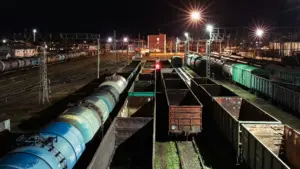
The safety culture reminder comes from TAIC’s final report on a runaway wagon movement at Port Otago marshalling yards. In the middle of the night, a remote-control operator and a rail operator were moving 25 wagons for freight transfer at the Port Otago rail marshalling area.
They parked nine wagons into Road 1 on a slight gradient then moved the locomotive to collect the remaining wagons for Road 2. While they were between the locomotive and the second set, coupling the locomotive and the wagon, the nine wagons in Road 1 rolled back down the gradient toward the pair.
The crew became aware of the movement only moments before impact. The rail operator got clear in time, and the remote-control operator applied the emergency brake to bolster the already-stationary locomotive.
Seconds later, the wagons from Road 1 struck the locomotive, pushing it backwards into the area where the workers had been and uncoupling it from the wagon already attached. No one was injured, but the locomotive and wagons sustained moderate damage.
The immediate cause was straightforward; the wagons in road 1 were not secured correctly. The required controls were not fully applied, so the brake system released when its air equalised.