

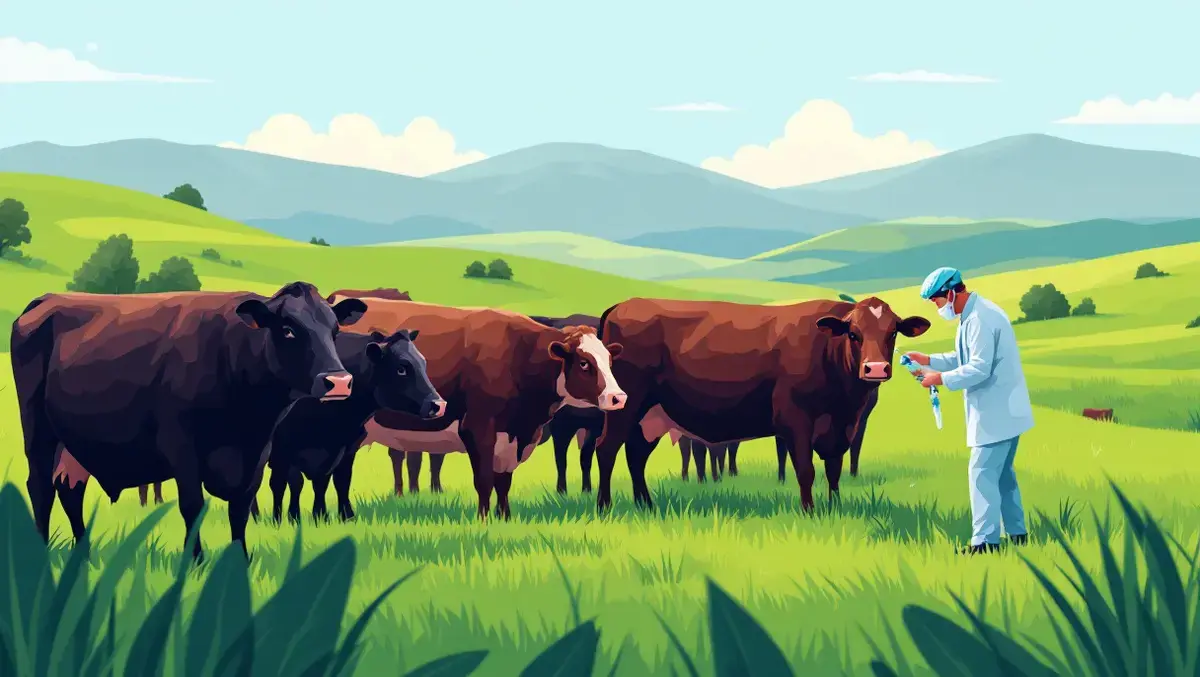
Lucidome Bio raises USD $9 million for methane vaccine
Wed, 11th Nov 2026 (Today)
Lucidome Bio has raised USD $9 million to advance development of its methane vaccine for grazing livestock. The round includes backing from existing investors including the Bezos Earth Fund, Meat & Livestock Australia, AgriZeroNZ and the New Zealand Agricultural Greenhouse Gas Research Centre.
The Auckland-based company said the funding will support further research and a series of cattle trials due to begin over the next 18 months. It is developing a vaccine aimed at methanogenic archaea, the microbes responsible for methane production in ruminants.
Different route
Methane from livestock remains a major source of agricultural emissions. Several approaches being developed elsewhere rely on feed additives, controlled feeding systems or delivery methods such as a bolus. Lucidome Bio is pursuing an alternative designed for animals raised in pasture-based systems.
Its vaccine is intended to prime the animal's immune system to reduce methane generation without affecting health or productivity. The approach has particular relevance in New Zealand and Australia, where cattle and sheep spend much of their lives grazing rather than in feedlots.
Bridgit Hawkins, Chair of Lucidome Bio, said the company has focused on how the product would fit farm operations. "Farmers need tools that work within existing farming systems. Our focus has always been on developing a practical solution that can work across dairy, beef and sheep systems," Hawkins said.
She said pasture-based agriculture presents specific constraints. "Pasture-based farming systems are some of the most efficient food production systems in the world, but they present unique challenges when it comes to methane reduction. We believe those systems require solutions specifically designed for the way farmers actually farm," Hawkins said.
Investor backing
The involvement of agricultural and climate investors adds weight to the project at a time of growing scrutiny of livestock emissions. The New Zealand Agricultural Greenhouse Gas Research Centre said the investment reflects the need for multiple options for farmers seeking to cut emissions while maintaining productive businesses.
Naomi Parker, Executive Director of the New Zealand Agricultural Greenhouse Gas Research Centre, described the vaccine as a possible addition to existing approaches. "New Zealand farmers need fit-for-purpose tools that work within pasture-based farming systems. Lucidome Bio's vaccine approach has the potential to become an important addition to the toolbox available to farmers, and we're pleased to support the next stage of its development," Parker said.
AI in research
Alongside its biological research, Lucidome Bio is using artificial intelligence tools in vaccine development. It is using AlphaFold, the protein structure prediction system, to help identify and refine vaccine targets.
This work builds on earlier research characterising methanogens in farmed ruminants around the world, with the aim of targeting multiple methanogens with a single antigen. The company is also working with British researchers through the Bezos Earth Fund partnership to use monoclonal antibodies to reverse engineer antibody targets.
Hawkins said those tools are changing the pace of research. "AI-powered tools are helping us understand biological systems at a level of speed and precision that simply wasn't possible before. It enables us to identify promising pathways faster, improve vaccine design and make smarter research decisions throughout the development process," she said.
Wider pressure
The fundraising comes as governments, farm groups and investors look for ways to reduce agricultural methane without disrupting food production. In countries with grazing-based livestock sectors, technologies that depend on tightly controlled feeding systems can be difficult to apply at scale.
Lucidome Bio has also attracted attention outside New Zealand, including recognition as a finalist in an animal health and nutrition innovation showcase in Boston. The latest round suggests investors spanning agriculture and climate are willing to keep backing the long-term scientific effort needed to bring such a product to market.
For Hawkins, the significance of the raise lies in who is backing the work as well as the amount secured. "This is validation from organisations that understand both agriculture and climate change. These investors have looked closely at the challenge, assessed the technology and chosen to support it. That gives us confidence that we're developing world-leading science with the potential to make a meaningful difference for farmers and the environment," she said.
She added: "For too long, methane reduction has been framed as a trade-off between environmental progress and farming practicality. Our goal is to help change that by developing a solution that can reduce emissions while fitting the way farmers actually operate."