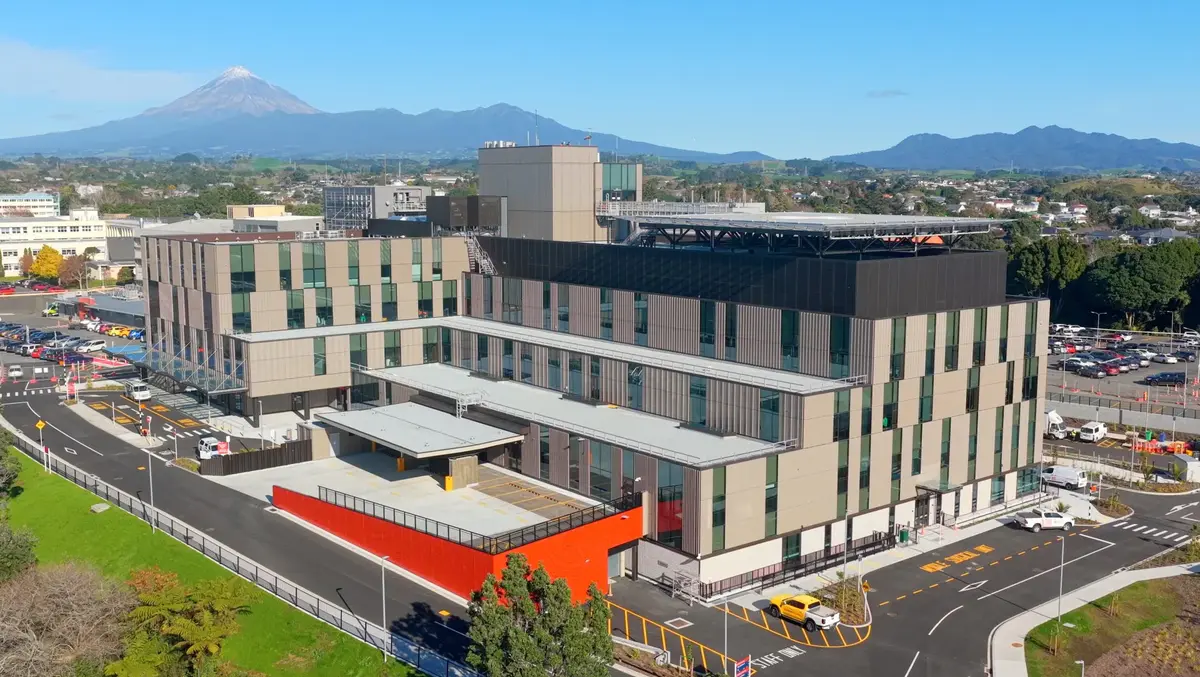
'Corridor caring from day one': New Taranaki ED still overwhelmed by patients
Fri, 30th Oct 2026 (Today)Despite a $462 million development at Taranaki Base Hospital, its new larger Emergency Department was still overwhelmed in its first few weeks of operating.
When the new East Wing opened in late June, the new ED had 32 treatment spaces compared with 26 in the previous department, including additional resuscitation spaces and dedicated fast-track treatment areas.
A government media release marking the building's opening said it featured "a significantly expanded emergency department with around double the current capacity".
An ED nurse, who spoke to RNZ on the condition of anonymity, said the department had been under pressure from day one, and was "blown away" by how the improvements were described at the time of its opening.
"What was it, double the size or whatever, and how amazing that is, but actually it might be in footprint, but it's definitely not in treatment spaces.
"And there's been an increase in patients as well, so you try and manage more patients with pretty much the same amount of bed spaces as what we had."
Health NZ's group director of operations for Taranaki, , said while the new ED had significantly improved capacity and patient flow, no ED could entirely eliminate periods of high demand.
"Like emergency departments across New Zealand, Taranaki's ED experiences periods of high demand, particularly during winter."
From 1 July to 28 October, the new ED at Taranaki Base Hospital recorded 107 red alerts and 170 amber alerts in 2026, compared with 94 red alerts and 145 amber alerts over the same period in 2025 in the old department.
A red alert indicates a greater than 135 percent occupancy rate during the day and 114 percent overnight and signals high operational pressure and triggers internal actions to improve patient flow. An amber alert is triggered at a greater than 108 percent occupancy.
The ED nurse said staff had been told they would no longer have to care for patients in corridors when they shifted into the new building.
"When we moved in, there was definitely not going to be corridor caring here, but already, you know, we were corridor caring from day one, really.
"We don't have that many ambulances in Taranaki, so we can't, or we try not to ramp for too long, but even that, you know, sometimes we're ramping ambulances when we don't want to be, because there's nowhere to offload these patients."
Ramping refers to continuing to care for incoming patients in ambulances because there is no room for them in the ED.
Langlands acknowledged there was a transitional phase with the Acute Assessment Unit in the new wing not fully operational until May 2027.
"Until the AAU is fully operational, there may be occasions when patients are temporarily accommodated in the ambulance offload area adjacent to triage while clinical teams manage peaks in demand and patient flow. The new ED does not have designated corridor treatment spaces.
"The use of the ambulance offload area was agreed with ED and St John to support ambulance offload and turnaround times. Since the first few weeks of operation, ambulance ramping has not occurred in the new department."
The ED nurse said it had been a busy time.
"Every day is a bit different, but the other day and I was corridoring every ambulance that came through the door. I think we had about six patients down one corridor.
"And, you know, patients in the waiting room as well that we try and bring in and work up and we have to put back to the waiting room because there's nowhere to put them.
"I think recently there were more than 40 people in the waiting room because the whole ED was full."
Langlands said the Emergency Department waiting room had seating for 34 people.
"During periods of high demand, the number of people requiring assessment may exceed the available seating capacity.
"In these situations, clinical and operational teams implement a range of measures to manage patient flow, including the use of available clinical assessment and treatment areas, escalation processes, and coordination with inpatient services to support timely movement of patients through the hospital."
The ED nurse believed the pressure on the department was taking a toll on staff.
"Everyone's burning out, you know, the managers are dealing with roster shortages every single day because people are off sick, burnt out."
Langlands said the department was currently fully staffed with recruitment underway to replace three recent nursing resignations, representing 2.4 full-time equivalent positions.
The government media release at the opening of the new building said the $462 million East Wing brought together emergency, intensive care, radiology, diagnostics, laboratory, maternity and neonatal services together in one integrated acute care precinct increasing the number of patient spaces to 151, up 55 from the previous capacity - a 57 percent increase.
The project sat within a broader Taranaki Base Hospital redevelopment, which included the opening of a new $56.1m cancer centre, a mental health facility, a renal unit, an energy centre, resilience upgrades, and an earlier inpatient building.