

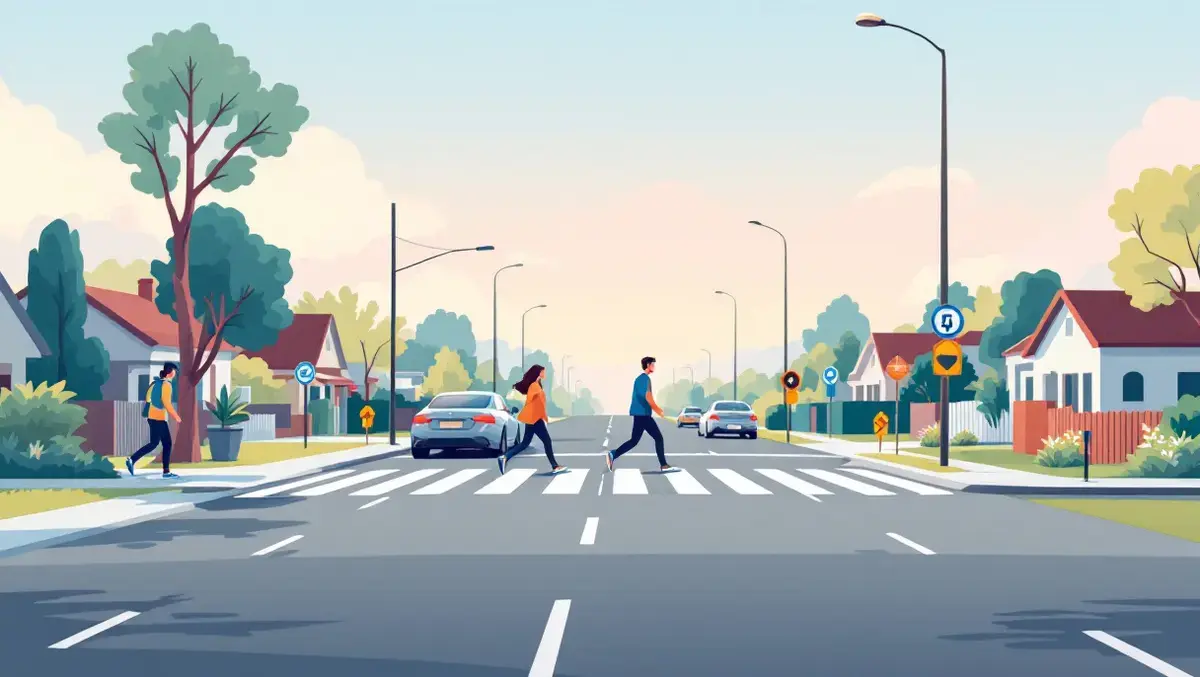
Austroads blueprint targets safer walking with lower speeds
Fri, 6th Nov 2026 (Today)
Austroads has released a Pedestrian Safety Blueprint for Australia and New Zealand, setting out measures to reduce pedestrian deaths and serious injuries.
The document brings together existing evidence and current practice for transport agencies working across policy, planning, investment and road design. It focuses on pedestrian data, road users, speed management, roads and paths, and vehicle safety, with advice on how to prioritise action and assess results.
Pedestrian safety has improved over the longer term, but that progress has levelled off in recent years. Australian pedestrian deaths rose from 133 in 2021 to 197 in 2025, underlining the pressure on agencies to move more quickly on measures already shown to work.
Modelling through Austroads' Keeping People Safe When Walking project found that established interventions, if applied at scale and without constraint, could cut pedestrian fatalities and serious injuries by up to 90 per cent by 2050.
Speed focus
The Blueprint recommends a Safe System approach that tackles risk across the transport network rather than focusing only on sites with a record of crashes. It identifies safer speeds as the most effective, cost-efficient and quickest way to reduce harm to pedestrians in the near to medium term.
This sits alongside a push for safer crossings and road environments designed to protect people when errors occur. The guidance places particular emphasis on urban roads and streets, where most pedestrian trauma occurs, including roads with speed limits of 50 km/h and 60 km/h.
It also highlights the need to consider locations used by people who may face greater pedestrian safety risks. The document is intended for transport agencies at local, state, territory and national level, while allowing for differences in local priorities and administrative structures.
The Blueprint is structured to help practitioners turn existing knowledge about pedestrian risk into practical action. That includes moving beyond reactive responses and identifying risk in places where crash records alone may not show the full picture.
Data gaps
The guidance calls for stronger information on pedestrian risk and exposure. It recommends linking crash and hospital data where possible, improving information about pedestrian infrastructure, and using community insight to identify locations where danger may be under-recorded.
Michael Nieuwesteeg, Road Safety Program Manager at Austroads, said substantial reductions in pedestrian trauma were possible using measures already available to transport agencies.
“We know much more today about pedestrian risk and the measures that can reduce it. The challenge now is to apply that knowledge at greater pace and scale, using evidence to target investment where it can make the greatest difference,” Nieuwesteeg said.
The Blueprint also frames pedestrian safety as an issue that cuts across multiple parts of the transport system, from strategic planning to on-the-ground operation. It reflects a broader view that walking safety depends not only on isolated engineering treatments but on how networks are planned and managed as a whole.
Urban environments are a central concern in that approach. Most pedestrian trauma occurs on roads and streets in built-up areas, making those settings a key focus for intervention, especially where traffic speeds remain high enough to increase the risk of death or serious injury in a collision.
For transport agencies, the document offers a way to assess where interventions may have the greatest effect and how progress should be measured. Its recommendations span both physical infrastructure and the quality of the underlying information used to guide policy and spending decisions.
Nieuwesteeg said pedestrian safety should be built into the operation of the wider network rather than treated as a narrow design issue.
“Pedestrian safety needs to be considered as part of how we plan, design, invest in and operate the whole transport system. That means understanding where people need to walk and cross, designing for people of different ages and abilities, and creating road environments that remain safe when people make mistakes,” Nieuwesteeg said.