

How WorkSafe is changing the way it works with industry
Sat, 11th Apr 2026With an average of more than one person dying at work in New Zealand every week, WorkSafe New Zealand is changing how it writes guidance, how it enforces the law, and how it works with industry. Meeting the moment with a different approach to enforcement, says WorkSafe New Zealand Chief Executive Sharon Thompson
Chief executive of WorkSafe New Zealand, Sharon Thompson, was appointed by the Minister for Workplace Relations and Safety, Brooke van Velden, in October 2024 and is responsible for driving the delivery of the crown agency’s strategy and operating plan.
In this article she sets out exactly what a sharper, more proportionate approach to workplace safety looks like in practice and what the regulator expects from the sectors it oversees.
“WorkSafe is in genuine transition, in service of a clearer, more useful relationship with the businesses and workers we exist to serve.
The Minister’s 2025 Letter of Expectations set out three clear shifts for WorkSafe: proportionate action, practical guidance and clear, consistent advice.
Everything we are doing is aligned to that direction. We have updated our Enforcement Decision-Making Model to align with the Solicitor-General’s Prosecution Guidelines.
We have introduced formal warnings as a specific enforcement tool, sitting between improvement notices and prosecution.
“Everything I describe here — new ACOPs, industry-led pilots, the endorsement policy, the guidance refresh, proportionate enforcement — is focused on one outcome: fewer people being seriously injured or killed at work.
“But we cannot do this alone. The industry-led model only delivers better standards if industry actually leads.
Consultation periods are your opportunity to contribute to the standards your sector will be held to. Please take that opportunity seriously.
Enforceable undertakings
And we have brought pre-charge enforceable undertakings (EUs) into our toolkit for the first time. Enforceable undertakings are legally binding commitments. They require genuine acceptance of responsibility, systemic safety improvements, financial commitments to victims, and active monitoring by WorkSafe.
They are not a way out. They are a faster way through, delivering improvements immediately rather than after a two or three-year court process.
We now have 16 active EUs, the highest level in more than five years, with five accepted this financial year alone.
One recent example followed an incident where a worker sustained serious burn injuries. The agreement includes financial amends, a worker consultation initiative, lessons shared with industry, training seminars for the electrical sector, and a donation to the Burns Support Group.
That is what a proportionate response looks like: accountability, remedy, and industry improvement, delivered at pace.
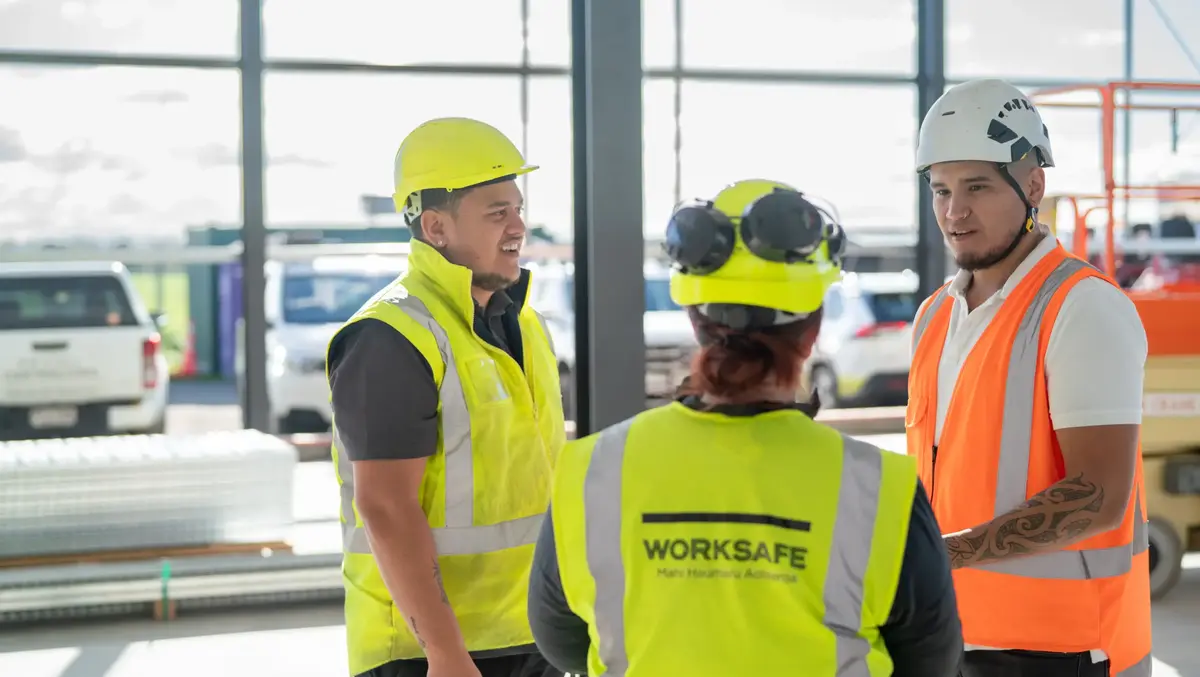
Workers at a Hawkins site at Auckland Airport
Engage early, accept responsibility
The point is not to reduce enforcement. It is to make enforcement more predictable and more transparent. Businesses that engage early, accept responsibility and fix the problem should not face the same response as those that do not. Guidance that actually works.
Guidance library
We took stock of our guidance library last year. We had hundreds of products, some outdated, some duplicated, some no longer aligned with current legislation. In May 2025 we withdrew about 50 of them. We still have more than 440 and significant updates are underway.
To manage this at the pace required, we are now using two AI tools. One rapidly synthesises consultation feedback so our teams can focus on decisions rather than sorting submissions.
The other compares each guidance product against the latest legislation on legislation.govt.nz, flagging where content has fallen behind.
Both are operated on a develop-trial-learn basis, with human judgement at the centre. Every AI suggestion is reviewed before any decision is made,” she says.
Approved Codes of Practice
Three new Approved Codes of Practice (ACOPs) are in development right now: roles and responsibilities in agriculture, safe farm vehicle operation, and roles and responsibilities in residential construction.
Public consultation on all three opens shortly, and all are due to the Minister by July. We are building these iteratively, with sector voices at the table throughout.
The forestry ACOP, launched last year, showed what good sector engagement looks like. We delivered workshops from Whangārei to Invercargill, reaching 344 forestry businesses.
The feedback was consistently positive. People valued the clarity, the dialogue, and the shift to consolidated, plain-language, risk-based guidance.
Inspectors at a recent machine safety training day in Christchurch
Industry-led ACOP
We intend to apply those lessons across every ACOP we develop. Industry needs to lead The Minister expects most future ACOPs to be industry-led.
Sectors with deep specialist knowledge should be empowered to develop their own information that reflects on-the-ground realities, written for the people doing the work.
WorkSafe’s role shifts from creator to system steward: setting standards, assessing quality, endorsing outputs. We are currently piloting this with two proposals selected from five expressions of interest.
The pilot is testing the readiness of both WorkSafe and industry bodies to develop Industry-led ACOPs. We know industries vary significantly in capacity.
Some have strong governance and project management, others are lean. The pilot will help us understand those gaps and what support structures are needed.
Funding models and roles need to be settled before we scale-up this approach, and we are being realistic about that complexity— but the opportunity is real.
Industry led ACOPs done well, will produce better outcomes than WorkSafe producing it alone – and that is better for workers and businesses.
Endorsement Policy
We have also updated our endorsement policy, creating a tiered spectrum from fully co-developed and endorsed WorkSafe guidance through to formal acknowledgement of industry resources.
If your organisation produces health and safety guidance, you can formally seek WorkSafe endorsement. Meeting our criteria gives your members confidence the material is technically sound and regulatory aligned.
If you are aware of guidance that workers are already relying on and you believe it is sound, bring it to our attention. Our visibility of industry-developed guidance is patchy in some sectors, and that intelligence is exactly what we need.
Sharper inspectorate
None of this works without a consistent, capable frontline. All inspectors now complete the same foundation programme regardless of where they are deployed. We have 203 inspectors and 37 trainees in place, and we are investing in investigative skills, manager capability, and consistent training across the country. In the first half of this financial year we completed nearly 7,000 workplace assessments, up more than 8% year on year, driven primarily by proactive activity.
Of those assessments 77% were in our four priority sectors: agriculture, construction, forestry, and manufacturing.
And 96% of businesses made at least one change to improve safety after interacting with an inspector.
That’s evidence that engagement, done well, changes behaviour.