

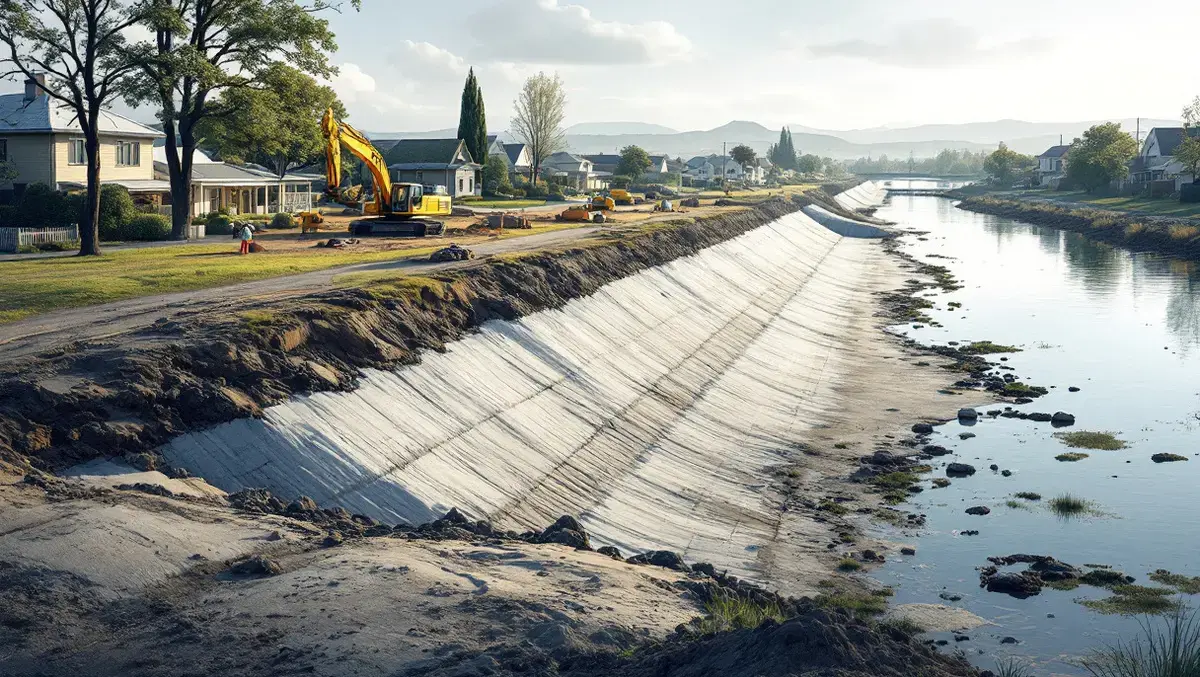
Waipawa stopbank upgrade begins after Cyclone Gabrielle
Fri, 13th Nov 2026 (Today)
Hawke's Bay Regional Council has started work on a stopbank upgrade in Waipawa as part of a wider regional flood-defence programme.
The project will raise and strengthen three kilometres of stopbank on the true-left bank of the Waipawa River, from Coronation Park to Rathbone Street. Updated flood modelling carried out after Cyclone Gabrielle shows the required height increase varies along the route, from a few centimetres in some sections to as much as two metres in others.
Construction is expected to continue until autumn 2027, followed by landscaping and reinstatement of the limestone walking path. Central Hawke's Bay contractor HES Earthmoving is the main construction partner.
The Waipawa upgrade is part of Hawke's Bay Regional Council's GBP £30 million programme to strengthen stopbanks across the region. It also sits within the broader North Island Weather Event resilience programme, which has a total budget of NZD $256.5 million and is jointly funded by central government and the regional council.
Central government is covering 75 per cent of the cost through cyclone recovery funding administered by National Infrastructure Funding and Financing. Hawke's Bay Regional Council is funding the remaining 25 per cent through rates.
Design standard
The upgraded stopbank is being designed to manage a flood with a 1% Annual Exceedance Probability, the standard used across Hawke's Bay's main flood protection schemes. The design also includes extra height, known as freeboard, to allow for uncertainty around future flood events.
The term "1-in-100-year flood" can understate the risk because it implies a regular pattern that does not exist. A 1% Annual Exceedance Probability means there is a 1 per cent chance in any given year of a flood of that size or larger, and such floods can occur more than once within a short period.
Officials have stressed that the upgrade is not intended to make the town flood-proof. Its purpose is to reduce flood risk for the level of event the structure is designed to withstand and to provide more time for people to move to safety in larger floods.
That distinction matters in Waipawa because Cyclone Gabrielle exposed the town's vulnerability when floodwaters breached the stopbank at Coronation Park and spread into lower-lying parts of the settlement. Homes were damaged and parts of the town were cut off for days.
For Tony Kuklinski, a Tamatea/Central Hawke's Bay constituency councillor, the start of construction marks a visible response to that damage.
"Cyclone Gabrielle hit Waipawa hard," said Tony Kuklinski, Tamatea/Central Hawke's Bay Constituency Councillor, Hawke's Bay Regional Council.
"When the river breached the stopbank at Coronation Park, floodwaters swept into lower Waipawa, damaging homes and cutting off parts of the town for days.
"Raising and widening the stopbank will give Waipawa greater resilience - and people greater peace of mind in their homes."
Local materials
About 60,000 cubic metres of gravel will be removed from the Waipawa River near the township. Material that meets engineering standards will be reused in the stopbank, linking river management work with the construction programme.
"We're looking at the river and stopbank as parts of the same system," Kuklinski said.
"Removing gravel helps manage the river channel, while reusing suitable material gives us some of what we need right on site.
"It's a smart use of local resources - good for the river system, the project and ultimately the community."
The wider resilience programme in Hawke's Bay includes stopbank upgrades at Lower Brookfields near Awatoto and at Ōmāhu, as well as new flood resilience work at Ōhiti Road | Ōmāhu, Pākōwhai, Pōrangahau, Waiohiki, Wairoa, Whirinaki and Havelock North. It also covers pump station upgrades and improvements to the river telemetry network used to provide real-time rainfall and river-level information.
Hawke's Bay Regional Council Chair Sophie Siers said the Waipawa scheme carries particular weight for residents whose homes were inundated during Gabrielle.
"For families who lived through Gabrielle, this project is visible proof that its hard lessons are being acted on," said Sophie Siers, Chair, Hawke's Bay Regional Council.
"It gives people something tangible to put their trust in - a stronger stopbank built to a modern standard, and the knowledge Waipawa is better prepared for the floods of the future."
Siers said the appointment of a local contractor was also significant.
"HES knows this place, knows the ground and understands what this project means locally.
"It's local people doing important local mahi."
Kuklinski said the broader challenge was to turn the experience of Cyclone Gabrielle into long-term improvements in public infrastructure.
"We cannot erase what happened during Gabrielle, and no stopbank can make an absolute promise. But we can learn, invest and build better - and make sure communities such as Waipawa are not left facing the next storm with yesterday's protection."