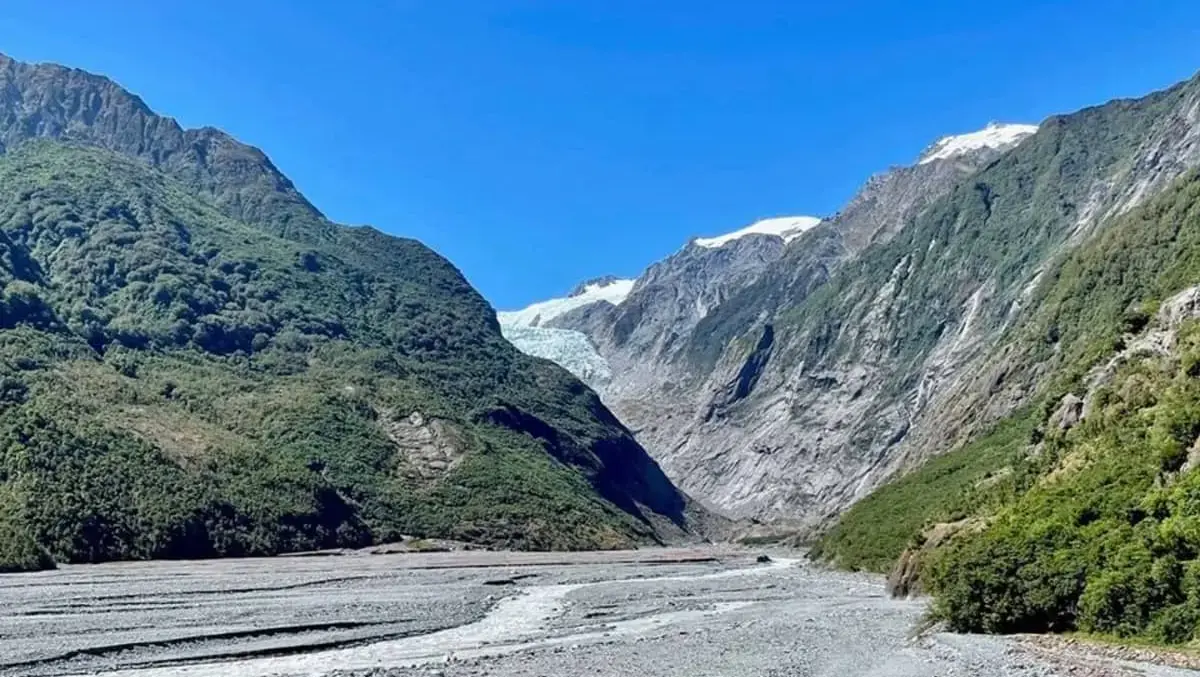
Scientists urge action over Franz Josef flooding risk
Fri, 23rd Oct 2026 (Today)
The flooding risk at Franz Josef Glacier has escalated and now poses a risk to life in the township, scientists say.
The bed of the Waiho (Waiau) River, which springs from the glacier, is now rising by 20cm due to the build-up of gravel as the retreating ice leaves the crumbling valley walls exposed.
Alarmingly, the riverbed is now 2m higher than the Franz Josef township.
The Waiho Technical Advisory Group (TAG) gave an exclusive briefing to the Franz Josef community last night, and called for urgency from the councils.
TAG has just reviewed the 10-year Waiho River Management Plan, concluding the West Coast Regional Council must act more urgently than the 10-year timeframe allowed in the plan.
A key part of the 2023 river management plan is to abandon the Waiho Flat farming district on the south side of the river, to allow the river to fan out naturally to alleviate pressure on the current stopbanks and avert the risk of flooding around the township.
However, the river has since changed, with the full flow of the Waiho now running into the adjoining Tatare River to the north due to an avulsion (breakout), leaving the south side high and dry.
At the briefing yesterday, Waiho TAG member Ian Fuller reiterated their 2023 recommendations to let the river fan out into the Waiho Flat by removing the stopbanks, prioritise emergency management measures, and improve existing stopbanks.
"We identified the avulsion as a threat in 2023, we recognised it as a potential to develop, but probably a bit more quickly that we had anticipated."
He reiterated that allowing the river to flow into Waiho Flat will prevent the flooding of Franz Josef.
"It will allow the river to spread its load over a much larger area and that reduces the rate of aggradation in the riverbed adjacent to the township."
As well as recommending the evacuation of the Waiho Flat, the TAG also urged "trigger action response plans" for emergency management.
He warned that the river management plan needs to be worked over a shorter timeframe due to the rapid build-up in the riverbed.
"We thought 10 years was a reasonable timeframe back in 2023. Essentially now we are working on a seven-year timeframe.
"What this river is telling us is that things are actually happening more quickly than that, so there is a real urgency for action."
Mr Fuller called on "urgent" and "strenuous" government investment to respond to the river crisis.
"This is an expensive exercise, I think something in the order of $100 million has been suggested. There has to be government-level investment here."
He suggested a national "programme of communication" to increase awareness about the Waiho River, "to promote the urgency of action required to respond to the increasing risk to life and property that is present here".
Mr Fuller said "millions" of cubic metres of sediment had been deposited into the upper valley -- between the glacier and the township bridge -- within the past year.
The TAG was concerned that this huge build-up in the upper valley will flow downstream to State Highway 6.
Since the Waiho had avulsed into the Tatare River gorge in 2023, the gorge had taken the "full flow" of the Waiho River, resulting in the riverbed being cut further.
The incision of the riverbed had increased as a result.
"In terms of the rate of incision, the rates are exceeding expectations. In actual fact, we are seeing much faster development, much greater deepening over the timeframe."
Mr Fuller also warned that the incision of the riverbed has exposed the toe rock at the Havill Wall, a stopbank built to protect the Westland District Council's sewerage ponds.
"The head of the avulsion will deepen the incision and progressively expose more toe over time and that further risks undermining the stopbank."
That was putting the sewerage ponds behind the wall at even great risk, he said.
Waiho Flat resident Kelley Molloy was today sceptical of the recommendation to let the river fan out into the south side.
"By their report saying 'hey guys, we will release the river to the south to save the town', it divides the town.
"If the shoe was on the other foot ... but people cannot see that and so they just get really tunnel visioned about it and it becomes a divided community which is quite sad in such a small community," Ms Molloy said.
Franz Josef businessman Logan Skinner, a member of the Waiho Rating District Joint Committee, was also critical of the plan to buy out the Waiho Flat.
"My fear is that we know central government has no money for a buyout, so what is being achieved by these reports and adding stress to people?"