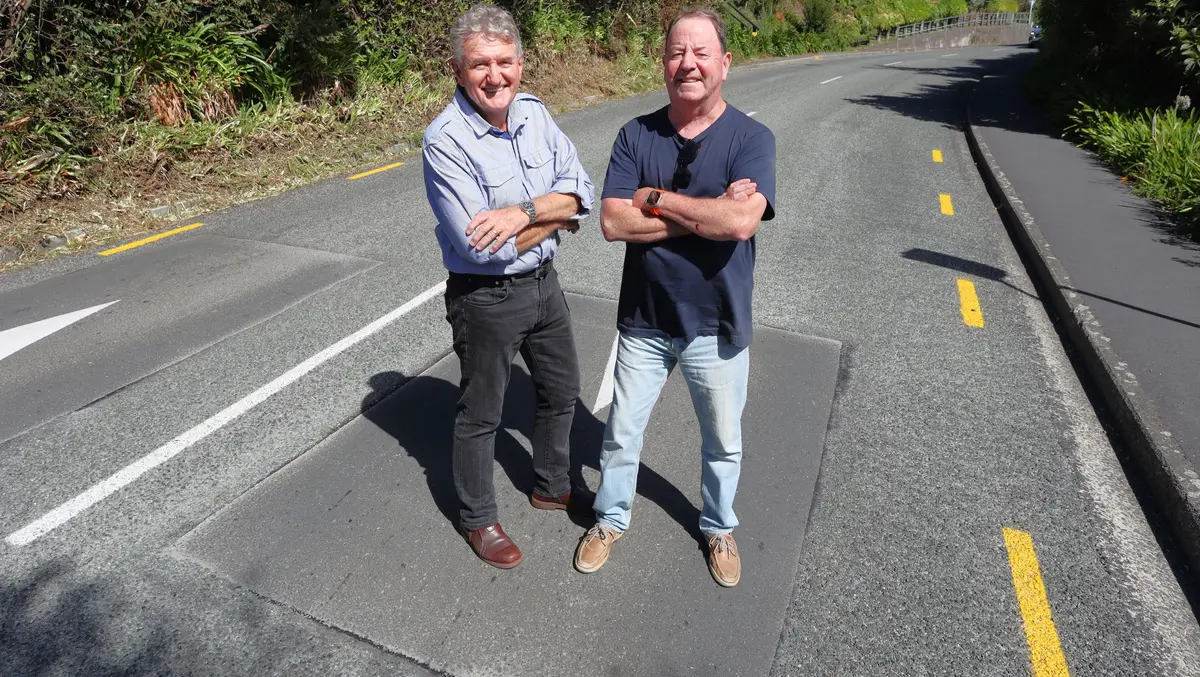
'Asinine' speed bump removal plan: Tāhunanui Hills residents forced to be first responders
Tue, 1st Sep 2026
Tāhunanui Hills residents who are sick of responding to crashes outside their homes are fighting plans to scrap a speed bump trial in their neighbourhoods.
The traffic-calming measures on Moana and Bisley Avenues are scheduled to be removed sometime during the next road resealing season, which begins in October.
Nelson City Council installed the speed cushions as a trial in 2024 to reduce driver speeds, crashes, and through-traffic after residents complained about traffic conditions.
They worked, with data showing the cushions slowed most drivers by around 10km/h, saw traffic volumes fall by about a quarter, and appeared to halve the number of crashes.
However, complaints about the noise of vehicles driving over them and vibrations at adjacent houses prompted some residents to campaign for their removal.
Subsequently, the council's elected members voted to remove the cushions on Moana and Bisley Avenues in March, against staff advice.
But a group of residents who want the speed cushions to stay will present to the council during its Thursday 3 September meeting in a bid to get elected members to change their mind.
Pauline Puklowsi described the road as "scary" before the cushions were installed, with many difficult driveways, fast drivers, and night racers.
"It was not safe… The worst part is lying in bed at night and hearing those cars scream around the corner, all the way from the bottom to the top, and just wondering if they're going to make it."
Having completed first-aid courses, she has gone to help people after crashes, but she was also worried for her own safety due to further dangerous driving or antisocial behaviour, like drunkenness and abuse, from those who had crashed.
"Being forced into that position of potentially being a first responder… I just don't think we should have to live like that, not when there's an alternative," she said.
Puklowski said the cushions had halved the number of crashes, so keeping them was a "no-brainer".
Nelson McEwan agreed. He was "overjoyed" when the speed bumps were installed and described their removal as "asinine".
"It used to be quite an unsafe road. It's got a lot safer… The data is quite clear."
He has responded to a couple of crashes outside his property, including one where a new driver took a corner too fast near where some children were walking.
"I saw her come to rest about 30 metres down the road," McEwan said.
"The council needs to set a higher standard for itself, and not compromise safety to the extent that they seem to be prepared to do."
Both residents feared increasing crashes when the cushions were removed.
A survey conducted by the group, targeted specifically at residents on Moana and Bisley Avenues and their side streets, found that 80% of respondents supported keeping the cushions in some form.
Their result contrasted with a council survey that found 63% of respondents in the trial area wanted the cushions removed, though that survey had a larger catchment that included other areas with traffic-calming measures, like Princes Drive.
Nicholas Lunn, a spokesperson for the residents' group that opposed the cushions, was also expected to present at the council's September meeting.
"We are opposed to any reversal of the council's position and will be arguing that case," Lunn said, but declined to comment further prior to his presentation.
Jeremy Matthews has previously fronted the council asking for the cushions to be removed and will return to the council chamber on Thursday.
Matthews said the vibrations caused by the city's eBuses and other heavy traffic driving over the cushions made a "very sound case" for their removal.
"Anyone with half a heart would agree that, if your house is being shaken every 40 minutes by passing buses and the rest, who could possibly tolerate that?" he said.
"It's very easy to say safety is more important, but when your house is literally being shaken by heavy traffic coming past, I would say that that is much more of an imperative."
He said signage prohibiting heavy traffic from using the route or speed cameras would be a better solution for the area.
An initial assessment by the New Zealand Transport Agency, which has sole responsibility for speed cameras, previously found that the route did not meet its criteria for installing the cameras.
National rules introduced by the current government also prevent the council from lowering the speed limit.
Nelson City Council has previously said that there was no budget to install different traffic-calming measures once the speed cushions were removed because no suitable replacements were identified.