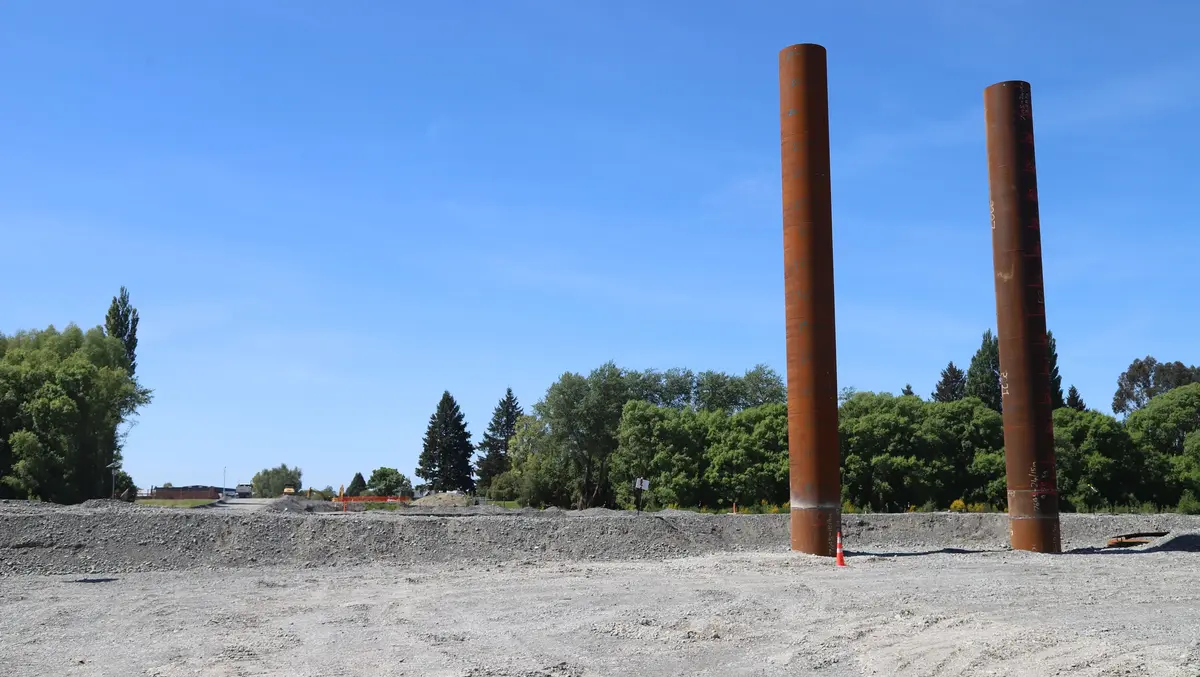
Ashburton second bridge project on track despite weather risks
Thu, 22nd Oct 2026 (Today)
The weather is the biggest threat to completing Ashburton's second bridge by the end of next year.
NZTA project director Lonnie Dalzell said everything is on track to build the new road bridge over the Hakatere Ashburton River.
"Despite what you hear out in the community at the moment, we are definitely on time and on budget."
The project still carries a budget between $134-$144 million, Dalzell said.
"We'll be materially completed by the end of 2027, but that's dependent on the weather.
"We constantly say that because we can't control the river."
Dalzell said they experienced a full site shutdown in August when the river experienced its highest flow in three years, shooting up over 300 cumecs – about 10 times more than its usual flow of 25-30 cumecs.
Working closely with MetService and Environment Canterbury, an advanced warning of the rising flow activated the flood response plan, giving the contractors three hours to evacuate the site, including the slow-moving cranes and other equipment out of the riverbed and floodplain.
River flows took a few days to drop to enable crews to re-establish the stable piling sites and resume working, Dalzell said.
Canterbury is facing a dry summer from an El Niño cycle, which increases the likelihood of stronger and more frequent westerly and north-westerly winds, with the potential for more heavy rain along the main divide of the Southern Alps where the Ashburton River originates.
"If we have multiple more rain events, that might push us back."
The installation of the heavy super T beams is also wind dependent, Dalzell said.
"Because you've got a big 60 tonne beam hanging over the crane, you don't really want it to be too windy trying to line it up. It's a health and safety nightmare."
Dalzell said driving the piles for the new bridge is reaching the halfway point, with 14 of the 28 pile casings installed or in the process of being installed.
Crews will jump to the Chalmers Avenue side, the northern side of the river, before Christmas.
Currently, there are around 70 workers on site, and there have been close to 60,000 work hours completed since construction began.
Once the piles are completed, the columns will be attached and crossheads installed to support the structure.
The cranes will lift large precast concrete super T beams into place.
Concrete is then poured to form the bridge deck, with asphalt laid on top to create the road surface.
Dalzell said that once they have some super T beams in place on the south side, they will shift the river channel, which has been temporarily redirected into one central channel through the bridge site to allow the two central piers, where the water is currently flowing, to be worked on.
Not just a bridge
The whole project spans 2.4km.
At the northern end, the new intersection at Chalmers Ave and South Street will be "substantively done by the end of the year".
"We need to have that done because we're mucking around the residents there and we want to make sure we get them sorted, but we also need it open for the super T beams to be able to come in as well."
The new bridge is actually two bridges – one across the Hakatere Ashburton River and the second across the Tinwald floodplain on the south side of the river, spanning around 600m.
From there, a new road will link to a new roundabout at Grahams Road.
"We're focussing on the intersections first because we have to close them down.
"Many of the intersections will be up and running over the next six months, but the whole road won't be connected until the end of next year."
The new sections of road between the intersections will take the longest, Dalzell said.
They have to install the new water main and other utility connections, stormwater and drainage, "and then we build our pavements on top of that".
"The only curb and channel we have are at the intersections, the rest is just open swales."