Our first experiences of advanced artificial intelligence are usually through large language models like OpenAI’s ChatGPT or Google’s Gemini. The emerging battleground is not in the world of knowledge and words, but in physical space — cue the physical AI revolution This year automakers are integrating AI into the workplace, says mobility specialist Movemnt.
As AI begins to sculpt algorithms and command the apps we use, developers have set their sights on a new landscape with which to drive smart innovation – physical AI.
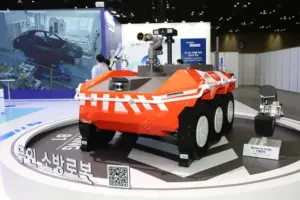
Hyundai is among the automakers betting on physical AI solutions and is developing intelligent robots to act as front-line firefighters for the Korea National Fire Agency.
These robots are designed to operate in initial fire suppression and search missions that may be inaccessible to human firefighters. They are equipped with a water cannon, vision-enhancing cameras and remote-control operation.
“Hyundai Motor Group will continue to provide the technologies and support needed to ensure that firefighters can carry out their missions in a safer environment,” says the group’s Executive Chair Euisun Chung.
The initiative responds to the 1802 firefighter casualties recorded over the past decade,
Chung says and the robots represent “technology that saves lives,” adding that they are designed to act as “reliable teammates,” entering dangerous scenes first.
Acting Commissioner Seung-ryong Kim described this as a breakthrough in disaster response. “This initiative marks the first step in a paradigm shift that will redefine disaster response.
“We will continue to actively introduce advanced technology to the field through innovative collaboration with the private sector, including Hyundai Motor Group.”
Hyundai is also supporting the upcoming “National Fire Hospital” with vehicles and rehabilitation equipment.
The group’s mission represents the first step in demonstrating how physical AI, if used correctly, could work in a hybrid network with human workers to carry out tasks that are particularly dangerous or undesirable for human beings.
Robots on the factory floor
Legacy OEM BMW is also betting on humanoid robots to maximise efficiency on factory floors. The automaker will implement humanoid robots in its German plants as a means of boosting efficiency and bringing down manufacturing costs in the context of Europe’s beleaguered auto industry.
BMW began a trial in the US last year at a factory in South Carolina and has since introduced robots into its Leipzig plant. In Leipzig, a small number of humanoid robots, developed by Swedish firm Hexagon, will assist with the manufacturing of high-voltage batteries — a task that is particularly dangerous for human workers.
In South Carolina, during a humanoid pilot, robots were used to place sheet metal parts for welding in vehicles, a task that BMW described as “particularly demanding in terms of speed and accuracy while also being physically exhausting for employees.”
BMW is not alone in in using physical AI in its pursuit of efficiency-boosting
As corporations begin to embed AI into the ways they process data, make sales, and draft communications, many companies are also looking for ways to automate and implement AI in manufacturing processes, on factory floors, and to perform difficult or dangerous tasks that humans may not want or cannot do.
Automotive manufacturers are leading the charge. From Tesla to BMW, Toyota to Mercedes-Benz, automakers are developing humanoid or intelligent robots set to perform a number of duties such as repetitive assembly-line tasks. Toyota and Mercedes-Benz have announced they will integrate robots into the manufacturing process in the coming years.
Toyota has unveiled plans to introduce humanoids at a plant in Canada, while Hyundai is testing robots designed in conjunction with Boston Dynamics to be used in its production plant by 2028.
For Tesla’s Elon Musk, humanoid robots have an even more ambitious use. Tesla’s aggressive expansion is predicated on the sale of millions of humanoid robots, named Optimus, which the billionaire has claimed could “eliminate poverty